How to scan
The file guard checks locally with the SEC engine, a built-in antivirus scanner without an external program. It complements your existing antivirus. Findings are only reported, never deleted or moved.
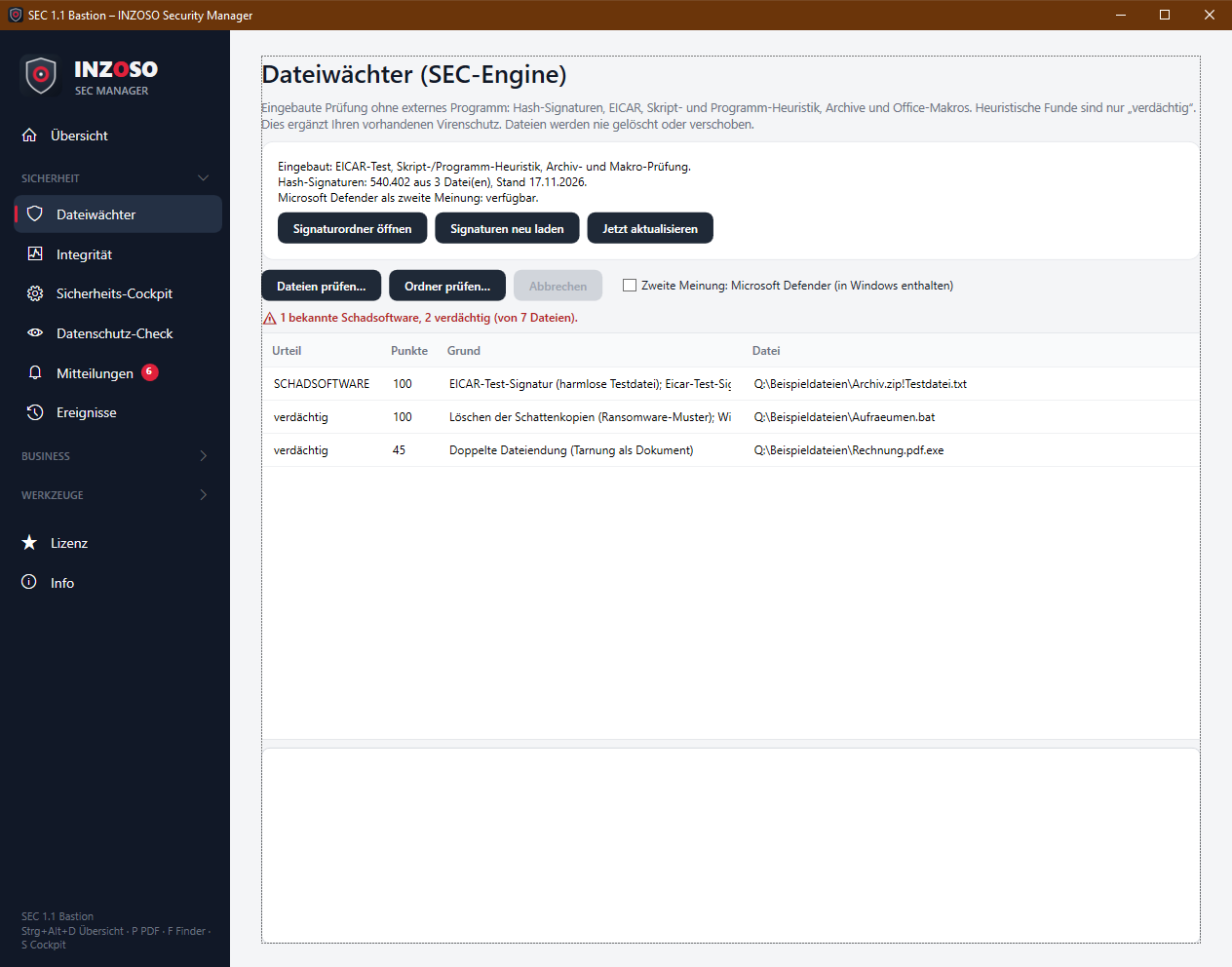
- Choose “Dateien prüfen…” (individual files) or “Ordner prüfen…” (including subfolders).
- The result appears at the top as a summary and in the table: verdict, points, reason, file.
- A double-click on a row shows the file in Explorer. For hits in archives the path contains “!”, e.g. Archiv.zip!Testdatei.txt.
- All findings are also written to the event log and reported as a message.
Verdicts
- SCHADSOFTWARE (malware): a clear hit, namely a known signature or the EICAR test file.
- verdächtig (suspicious): heuristics: several anomalies add up to at least 40 points. Please assess manually.
- Heuristic findings are never called “malware”. A valid digital signature of a program lowers suspicion by 30 points.
What is checked
- Hash signatures: known malware (MD5, SHA-1, SHA-256) from the ClamAV database
- EICAR: the harmless antivirus test file, also in archives
- File name: double extensions such as Invoice.pdf.exe (45 points) and Unicode reversal characters in the name
- Scripts (.ps1, .psm1, .vbs, .vbe, .js, .jse, .wsf, .hta, .bat, .cmd): e.g. encoded PowerShell commands, downloading and running code, AMSI bypass, switching off Defender protection, deleting shadow copies (ransomware pattern), switching off Windows recovery, deleting event logs, autostart by script
- Programs (PE files): packer sections, very high entropy, executable and writable at the same time, a combination of typical process injection or keylogger functions
- Archives and Office (.zip, .jar, .docx, .docm, .xlsx, .xlsm, .pptx, .pptm, .odt, .ods): contents are checked individually, VBA macros in documents that should not contain macros (45 points) or in macro documents (15 points)
Virus signatures
The page shows the state at the top, e.g. “Hash-Signaturen: 540.402 aus 3 Datei(en), Stand 17.11.2026.”
- Signaturordner öffnen: opens %APPDATA%\SecManager\signatures
- Signaturen neu laden: reads the files in the folder again
- Jetzt aktualisieren: loads new signatures through the official tool cvdupdate (Python required: pip install cvdupdate)
- ClamAV databases (.cvd, .cld; the hash signatures are read from them) and simple hash lists (.hdb = MD5, .hsb = SHA-1/SHA-256, format hash:size:name) are supported.
- With Premium the set updates automatically every 4 hours.
- If no signatures are loaded or they are outdated, the page says so explicitly. Only the test file and heuristics are then detected.
Second opinion with Microsoft Defender (Premium)
The option “Zweite Meinung: Microsoft Defender (in Windows enthalten)” also has the selection checked by Windows’ own Defender (via MpCmdRun.exe, without cleaning: Defender deletes or moves nothing). Nothing is installed. Result and output are in the lower text field.
Limits
- Files over 500 MB, single archive contents over 50 MB, archives over 200 MB total content or with more than 500 entries, nested archives and 7z/RAR/CAB are not checked completely. The result is then “unvollständig” (incomplete) and the reasons are in the lower text field.
- The pattern, logic and PE signatures of the ClamAV database are not evaluated yet. Detection is therefore narrower than with ClamAV itself.
- The file guard is not real-time protection. New downloads and USB drives are checked by the continuous monitoring or device protection (Premium).
- It complements, not replaces, your antivirus. No hit is no guarantee.